
Crypto and the Systematic Effects of Currency Standards

Your money is more valuable to you when you don’t own it.
How’s that for an opener?
Or how about this one: telling your kids to save their hard earned money is really bad advice.
Sure: it helps them build the discipline of delayed gratification—I’m not arguing that. What I am arguing is that our economy is so fundamentally broken that holding on to your fiat(government-based) dollars is the fastest way to decrease their value and buying power.
“Ok, Isaac, explain.”
Here’s an illustration: when you buy a house, there are a couple ways to do it. You can buy the house outright in cash, or you can supply a down payment and the bank will loan you the rest of the money for the house. I think I would be correct in saying that the majority of us assume the bank is giving you the money for your loan from their reserves or from the money other people have deposited. This would make sense, right? Banks hold everyone’s money and redistribute it through interest collecting loans or investments.
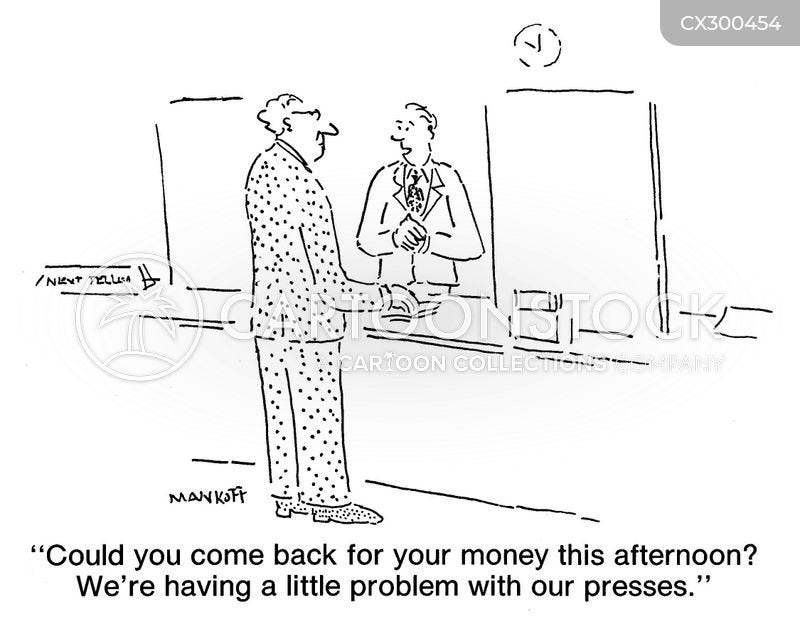
Unfortunately that’s not the case. It’s more like this: Every time a bank gives out a loan, they are creating new money. With the amount of mortgages and loans that are handed out annually, this massively devalues everyone else’s money every year(remember that scarcity is part of what makes something valuable)
If you’re like me, this hits like a gut punch when you first realize it.
This month I want to take a glimpse at how, systematically, our current fiat economy is actually the source of much more dysfunction than just inflationary currency. This is the root of my passion about crypto and why I think you should care: it’s not about getting rich. It’s about creating an economy that values things accurately.
An economy that devalues money fundamentally devalues humanity and everything we own.
Let’s examine more closely the idea that banks print money every time they give you a loan. There are some advantages for both parties:
1. You get the opportunity to realize the current value of something without
incurring any(or relatively very little) of the current cost.
2. The bank gets the opportunity to collect payments and interest on money that
doesn’t technically exist(or didn’t until the loan was taken out).
This means you’re going to be paying down a fixed number(the dollar amount of your mortgage) for a few decades—if you keep the house that long and don’t make egregiously large lump sum payments. While you’re paying down your mortgage, the buying power of the dollar is going to decrease anywhere from 2-15% every year(Canada’s average since 1915 is ~3%).
Are you getting the gist? Your loan is not increasing in dollar amount(aside from interest), but the dollar is decreasing in buying power. Your house is going up in value as an asset while your mortgage remains the same amount of dollars minus the amount you pay off every month. And that fixed set of numbers is going to decrease in value faster than you can pay it off. When you go to sell your house, it will be listed at its current market value—not the value you took a loan against however many years before. You are going to gain regardless of whether you have paid down your mortgage. This is why my neighbor paid $87,000 for their house a decade ago and similar homes are currently selling for well over $250,000.
At first glance, this seems like a win for you, right? Time to buy a house! Here’s the issue:
1. It’s only a win for you at the moment you become a homeowner and at the
moment you sell. Otherwise your money is devalued every time a mortgage or
loan is taken out by everybody else.
2. Even if you are a homeowner, you’re either forced to stay in your home for a
long period of time or flip houses fast enough to adequately keep up with the
rate of inflation. In my opinion, this detracts from quality of life due to it
creating a ‘head above water’ mentality(anxiety and lack of security/stability).
The losers in that scenario are everyone else who own fiat dollars that aren’t taking out a mortgage/loan at the same time. You and the bank shook hands on a mortgage/loan and printed some money together. Great for you! You were able to get your hands on an asset that would increase in value while the bank secured income from you for decades(in the form of interest). But the printing of money added to the total supply which made the dollar less scarce which drove down its overall value and buying power.
Big Picture
Zoom out. How many houses were bought and sold in your neighborhood last year? How many times do families move or purchase new homes in their lifetime? How much money did our governments give out as ‘relief funds’(print) since the beginning of 2020? Everyone is devaluing the dollar constantly.
‘So’, you say, ‘the solution is to do away with debt. No one can take out loans ever again. Only spend what you earn!’ Aside from the fact that this is grossly idealistic, it’s impossible to do so in the current set up and isn’t a realistic model for an economy.
There will always be periods of time in which we need to take out loans for one reason or another. Large, unexpected costs happen; sometimes at a faster or larger rate than we can save or prepare for. The difference is that we could build(and are building) an economy that supports self paying loans(this is already happening in the DeFi sector of crypto. Remember Aave?). Self paying loans work in an economy where the asset you borrow against(your crypto) appreciates in value over time so you can eventually pay off the loan with your asset while still having plenty left over.
“Ok,” you say, “But isn’t that what we’re doing with houses and other asset classes now?”
The difference with crypto is that the currency you borrowed(most likely a decentralized stablecoin like UST or DAI) doesn’t depreciate in value because it’s algorithmically balanced by deflationary crypto assets(see Terra’s UST).
That’s one possible iteration in a crypto or ‘hard money’ economy. In our current ‘soft money’ economy it goes more like this:
We all need goods and services to survive and thrive. But since our dollar is inflationary we can’t buy much with it after a relatively short period of time. Let’s call this short period of time ~5 years(what could $1,000 get you 5 years ago?). So we periodically take out loans, increase our credit limit OR sell assets to acquire our necessary goods and services in addition to our regular stream of income. Most of us are doing the first two and avoiding the latter: why would you sell something that’s going to increase in value over time when the dollar is going to decrease? Better to borrow than risk opportunity cost. So the dollar continues to lose value/buying power while we try to stay above it, and the vicious cycle continues.
Whether consciously or unconsciously, everyone knows(or at least senses) their dollar’s buying power is crap. We’re becoming acutely aware of it in this government-throwing-money-at-covid-accelerated season of inflation(but it has been there the whole time). The smart ones realized a long time ago that the only way they win is to accumulate loads of debt and keep cash flowing in and out of their bank account as fast as possible because the longer you hold that dollar the less buying power you have. The debt belongs to someone else—banks and governments.
This fosters an economy that encourages rapid cash flow and incessant consumerism because we all have to shed that valueless dollar as fast as possible(again, some of us are aware of the game, many are just trying to keep their head above water).
Manufacturers are then incentivized to provide products that have quick production time/turn around: they are cheaper to make, distribute, and purchase. This leads to products not being ‘market-tested’ over time. Consumers don’t buy the best quality things because their dollar is getting exponentially worse at buying anything of quality. Fewer and fewer people can actually pay for post-secondary education because it has become too bloated in cost—so banks(with the help of government) print more money to allow people to go to universities so they can earn an income that becomes less and less valuable every year.
THIS is why we live in a consumerism-driven society: Not because humans are inherently stupid and selfish: we would not have survived so long as a species if we were as dumb and selfish as some nihilistic critics claim us to be. We are so consumerist and wasteful because we have accepted a garbage economy as the only possible reality.
Slowly—but then suddenly—devaluing money has devalued humanity and the planet we live on. While we all try to keep our head above water, we destroy each other’s bank accounts and society and culture.
“Gee, Isaac. Thanks for the depression.”
As a friend would say: “Don’t talk to me about problems unless your willing to talk about solutions!”
Hard Money Economies
Thankfully, there IS a solution. Once upon a time, our society operated on a ‘gold standard’. The dollar was pegged to the value of gold, and money’s value and buying power was stable and even increased in buying power. Instead of incentivizing citizens to adopt a frenzied consumerist mindset to shed their dollars as fast as possible and ‘stimulate the economy’, a gold standard or ‘hard money’ standard encourages participants to only spend what they need to survive and have quality of life while saving the rest. Assets decrease in dollar amount over time because your dollar becomes more valuable over time. This doesn’t mean your asset is less valuable: a house is a house. Your money’s buying power surpasses the asset, meaning you are incentivized to save so you can be empowered to thrive in the future—not just survive, manage, or get by. More important on the systematic end: you are incentivized to only purchase what you need and only purchase the best quality. This incentivizes the market to create better quality products—which they can afford to do because their cash flow is now comprised of a hard money that gains buying power over time.
Bitcoin is a hard money: it has a fixed supply. The code of Bitcoin’s blockchain dictates that there can never be more than 21 million Bitcoins in circulation/existence. If there were, the validating nodes on the blockchain network would disallow transactions. Remember: scarcity has a significant impact on value.
Keep in mind that Bitcoin isn’t the end all and be all: its utility is not great. The network processes transactions slowly and you can’t currently use Bitcoin for anything other than peer to peer transactions—for now. There are ecosystems like Stacks being built on top of Bitcoin’s blockchain to use the hard money security of Bitcoin as a base layer for transactions—utility is coming.
The Point
Our current financial ecosystem is crap, and it’s not just because of Covid. It has been crap for decades. A fiat economy can only ever decrease or increase the rate of inflation. It cannot eliminate it because inflation is part of the nature of fiat currency. You are paying(or soon going to be paying) higher interest rates because we relied on an inflationary system in the first place—not because covid surprise-attacked our economy. If we built on a deflationary currency that wasn’t centrally controlled(more on this in the next newsletter) we would resolve an unbelievable amount of systemic issues because—consciously or unconsciously—humans only want to spend money on things that accurately reflect the value of our money.
Dollar stores likely wouldn’t exist. And if they did, there’d be a lot less of them and they would be required to pare down to a specific type of product to make it worth our currency.
Universities would be affordable and forced to pare down their courses to things that only had practical, market-tested value—no more general degrees that cost tens of thousands and don’t help you get a job.
Food would be better quality because we would be empowered to only buy the best of the best—and we would only want to.
Loans would stop being a part of everyone’s financial portfolio and only exist where absolutely necessary. It would also be feasible to pay large loans off in a reasonable amount of time.
What do I do?
How can we start building a hard money society now? How can you practically do something about this right now? Here’s some things I do:
1. Purchase and use Bitcoin or tokens that build on it. These include:
- BTC
- STX
- Bitcoin Cash
- Investigate and/or support Strike and the Lightning Network
2. Use Bitcoin in any transactions you think are worth the opportunity cost(this is a good experiment to study how you value your own currency’s buying power). There's more than you think.
3. Participate in networks that offer Bitcoin rewards. This could be as simple as depositing your Bitcoin to an earn account on something like crypto.com to accumulate Bitcoin. You could also deposit a minimum of 50 STX on okcoin to receive Bitcoin rewards. These are two examples of many opportunities that exist.
4. Buy ETH. Instead of a fixed supply, EIP-1559 burns a bit of ETH with every transcation on the Ethereum blockchain. This makes the currency more scarce while still allowing new coins to be minted through mining/staking. Then use it on the ethereum blockchain or other Layer 2’s like Polygon, Optimism, ZKsync, or Arbitrum. There are plenty of practical reasons to do this.
5. Buy tokens that have built on Ethereum(MATIC) and use them in their respective blockchain ecosystems.
6. Pay attention to what’s happening in our current economy and vote for the politicians who acknowledge that the current ecosystem has to change at a fundamental level.
7. Never buy into CBDCs(central bank digital currencies) these are just more concentrated fiat money systems parading as blockchain tech. The fundamental difference is their lack of decentralization(again, more on this in the next newsletter).
Conclusion
Much of this month’s newsletter is informed and inspired by author of ‘The Bitcoin Standard’ and, ‘The Fiat Standard’ Dr. Saifedean Ammous. Dr. Ammous is well versed in economical theory and known for his harsh criticisms of our current global financial system(s). And while the titles of his books suggest he is a crypto nut or ‘Bitcoin maximalist’ his argument has a lot more to do with hard money vs soft money. His work highlights that our current world economy is built on debt slavery and we can do much better. To take a deep dive on the systemic impacts of inflationary economies, check out this interview with Dr. Saifedean Ammous on Impact Theory.
—
#OnCrypto has one mission: on-board as many people as possible to the ever expanding ecosystem of cryptocurrency and blockchain tech. This isn’t my mission just because I think it’s cool or fun(though it is those things). It has a lot more to do with seeing this as a potentially massive improvement on quality of life for all people. If you’d like to learn more about the crypto space and you do better with one-on-one training and consulting, shoot me a message.
See you next month.